
Discover why Thunder Bay is one of Canada’s best destinations for ice climbing. Just a 90-minute flight from Toronto, world-class frozen waterfalls and expert guides are waiting.
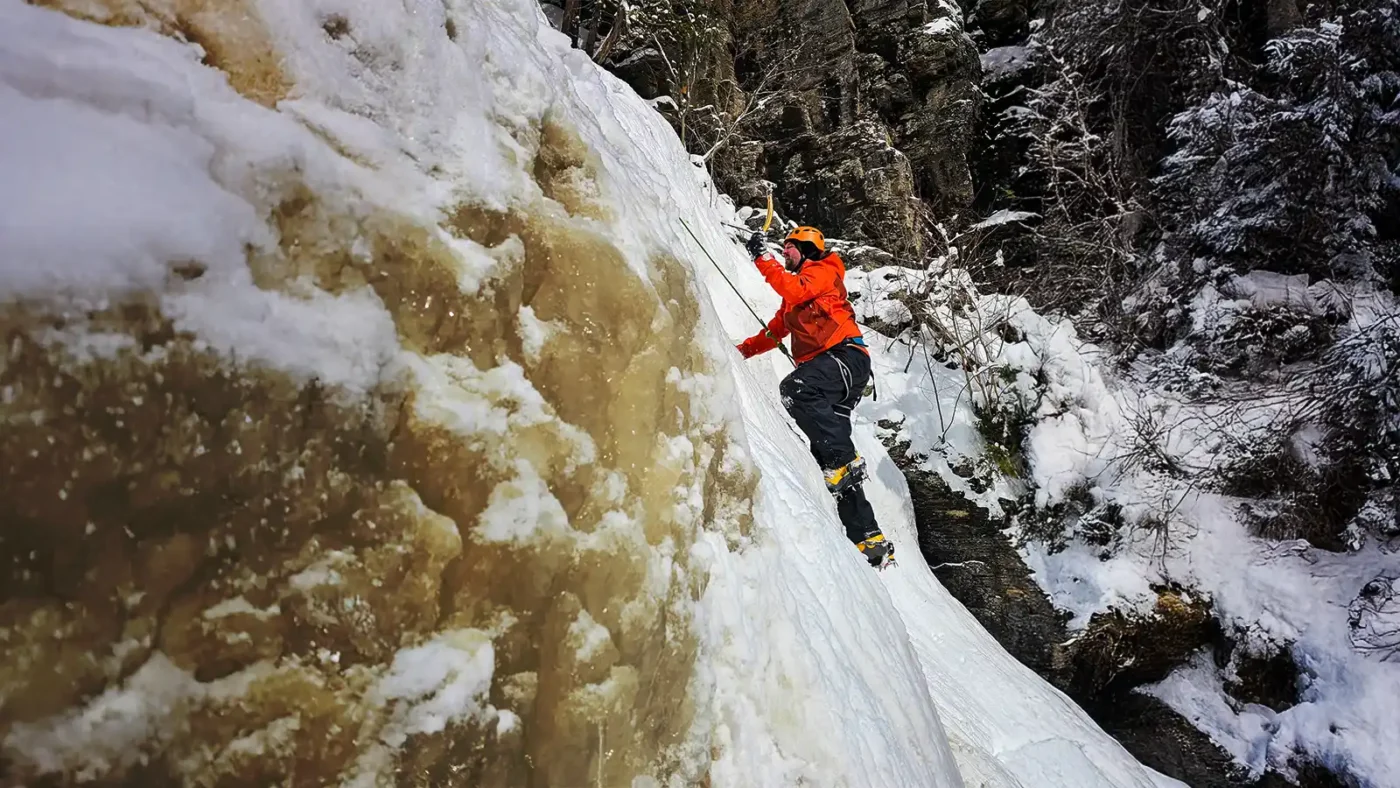
Thunder Bay is one of the best ice climbing destinations in Canada. For those deep in the sport, it’s actually world-class. And it’s ninety minutes from Toronto.
Most people have no idea. Here’s how I discovered ice climbing in Thunder Bay.
Thunder Bay doesn’t wear adventure on its sleeve. This city sits quietly up there on the northwest tip of Lake Superior, buried under fifty centimetres of fresh snow, waiting for the people who are paying attention.
I’ve travelled to Thunder Bay plenty of times before. Epic road trips along Highway 11 through Lake Superior Provincial Park, cresting the northside of those monstrous waters. Camping along the Boreal Route alongside waterfalls and gazing out at legendary Northern Ontario sunsets.
This section of Northern Ontario is a piece of paradise in my eyes. I’d hiked to the top of the Giant in Sleeping Giant Provincial Park, gone amethyst mining with my kids just outside of town, and sailed Lake Superior with Sail Superior. These summer getaways still rank among my favourite Ontario travel memories. Pair those with the great restaurants, dining at Red Lion Smokehouse, the amazing Thai food at Thai Kitchen, and of course, those soft, doughy Persians that only those who have been to Thunder Bay can truly understand.
Why Thunder Bay Is One of Canada’s Best Ice Climbing Destinations
Stretching from the town of Nipigon in the east to the Minnesota border in the west, the Thunder Bay region contains hundreds of frozen waterfalls, ice curtains, and mixed climbing routes that rival anything west of the Canadian Rockies. The difference is that visiting Banff, Alberta, means a five-hour flight and a budget that makes your credit card wince.
Thunder Bay, on the other hand, is a ninety-minute flight from Toronto, accessible from both Pearson International and the downtown Island Airport, and priced for people who live in the real world.
Northern Ontario’s epic geography does the heavy lifting for the ice climbing scene. Dramatic Canadian Shield terrain, consistently sub-zero temperatures throughout winter, and an abundance of rivers and creeks that freeze into spectacular formations all come together to make this one of the most naturally gifted ice climbing landscapes in the country.
The Thunder Bay ice climbing season typically runs from late December through March, with January and February offering the most reliable and fully formed ice conditions.
For Ontarians who have never considered ice climbing, Thunder Bay is the ideal place to start. The combination of accessible terrain, professional guiding services, and that unmistakable Northern Ontario hospitality creates conditions where even a complete beginner can have a legitimate, challenging, and deeply satisfying experience on the ice.
I am living proof of that.
Arriving in Thunder Bay: Blizzards, Hockey, and Great Sweet Potato Fries


The city I landed in was still digging itself out from three straight days of near-blizzard conditions. The storm had dropped fifty centimetres of fresh snow on Thunder Bay, and city workers were moving with urgency, carving corridors through towering banks of white.
The roads were slick. The sidewalks were a mess. I picked up my rental car and pointed it toward the historic Courthouse Hotel, perched above Lake Superior with views straight out to the Sleeping Giant.
Hockey is a sport close to my heart. Both my kids play, and I’ve spent the better part of the last decade either coaching, training, or driving them back and forth from the rink. My friend Erin, a Thunder Bay local with her finger firmly on the pulse of the city, suggested the Lakehead Thunderwolves hockey game at Fort William Gardens.
Let me tell you this. The crowd that packed that arena for a university hockey game put to shame our local Brampton Steelheads. Northern Ontario’s relationship with hockey is something else entirely. The Thunderwolves beat the Brock Badgers 2-1 in a playoff elimination game, and the place erupted.
Dinner at The Foundry afterward was exactly what the night needed. Buttermilk chicken burger, sweet potato fries that were genuinely exceptional, and live music that filled the room with the kind of authentic local energy that seems to be slipping slowly from the nightlife of cities across the province.
I would have happily stayed until last call, but I kept one eye on the clock. Tomorrow was going to be a big day, and I was not entirely sure I was ready for it.
Ice Climbing in Thunder Bay: My First Time on a Frozen Waterfall
Aric Fishman ushered me into his home with the quiet smile of someone who is more comfortable on a rock face than with introductions. He quickly brought me downstairs to a prep room packed to the rafters with ropes, crampons, harnesses, and helmets. I greeted his golden Labrador, Summit, with a smile and a vigorous ear scratching. That seemed to put a nick in Aric’s quiet demeanour, and he instantly relaxed.
Aric runs Outdoor Skills and Thrills, and within about thirty seconds of meeting him, I understood that this was a man who genuinely loves what he does. Not in the way people say “I love my job”. But in the way that means he will spend his friday’s scouring ice formations across the top of Lake Superior so his clients get the best possible experience on Saturday morning.
Aric got me geared up with everything that I needed. Helmet, harness, crampons, and ice axes. He’d let me know ahead of time to be prepared with proper layers, waterproof outerwear, and decent waterproof gloves.
The 40-minute drive toward the Minnesota border and Pigeon River Provincial Park gave me time to contemplate what I had gotten myself into. Aric and I chatted energetically over the radio that he provided. The sunshine was already sparkling off fresh powder as we wound through the boreal forest that looked almost unreasonably beautiful in the morning light.
That’s No Hike
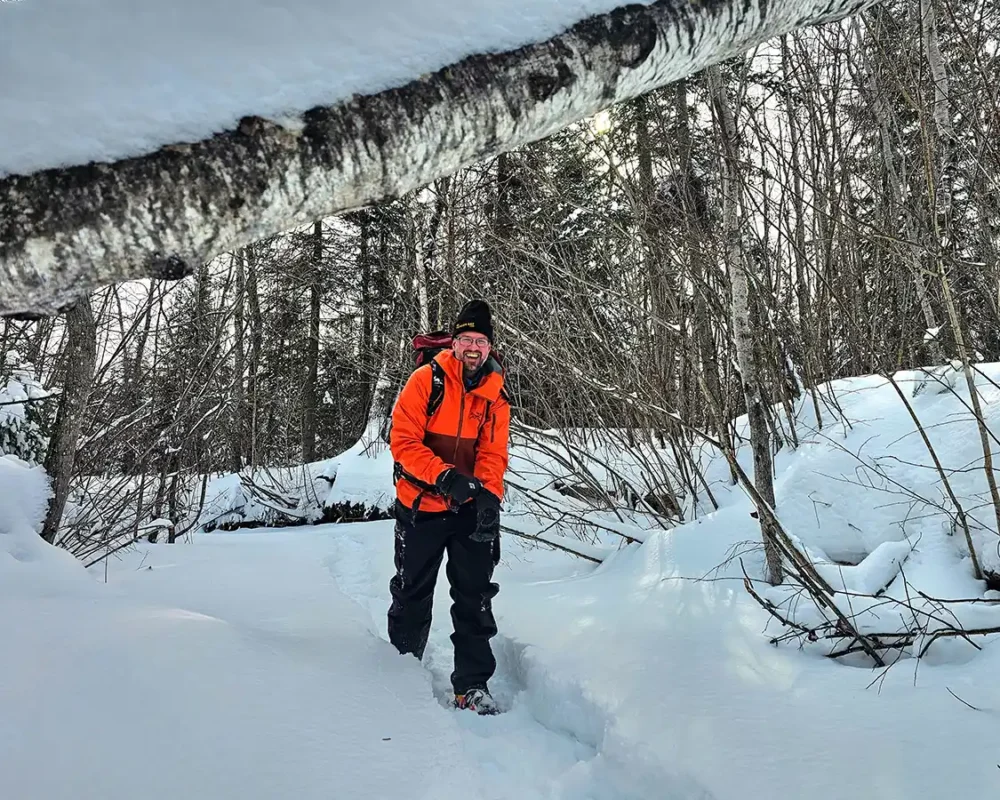
When we arrived at the trailhead, Aric assessed the conditions and delivered the first twist of our day calmly. The trail to the frozen waterfall was completely snowed in. What should have been a 15-minute hike was going to be considerably more involved.
We strapped on snowshoes and pushed into the forest. The snow was waist-deep and as soft as anything I have ever walked through. Summit bounded ahead, occasionally disappearing entirely into drifts before resurfacing with the expression of a dog who has just confirmed that life is, indeed, wonderful. At one point, the drifts and fallen trees proved too deep even for him, and Aric was forced to stop and lift her over downed trees and fallen rocks with the practiced ease of a man who has done this many times before.
The hour-long snowshoe was one of those obstacles that turned out to be exactly the right kind of adventure. I had just spent a week prior snowshoeing sections of the Trans Canada Trail down south, so this was comfortable territory for me. By the time we arrived at our destination, we had already earned something.
And there we were, a cathedral of ice and rock that would have been overrun with tourists down in southern and central Ontario. Here, they’re tucked away, barely thought about by most people, simply because so much of the Thunder Bay landscape is just as epic and beautiful.
The clouds drifted away, revealing bright blue skies in the narrow slit between the rocks and the trees above our heads. The crisp winter breeze, mixed with warm sunshine on our faces, felt like a reward. Three days of relentless snow had apparently cleared just for this moment.
The waterfall was gorgeous, even covered over from the days of relentless snowfall. Layers of ice built up over weeks of freezing temperatures, a wall of shimmering white powder with glimpses of tanin-stained ice gleaming through. Aric ran through the gear: crampons, ice axes, ropes, anchors. Where to swing, where to step, why the ice sounds different when it’s solid versus when it isn’t.
He set the anchors, dusted off some snow, and handed me the rope.
It was time to climb.
Finding the Rhythm
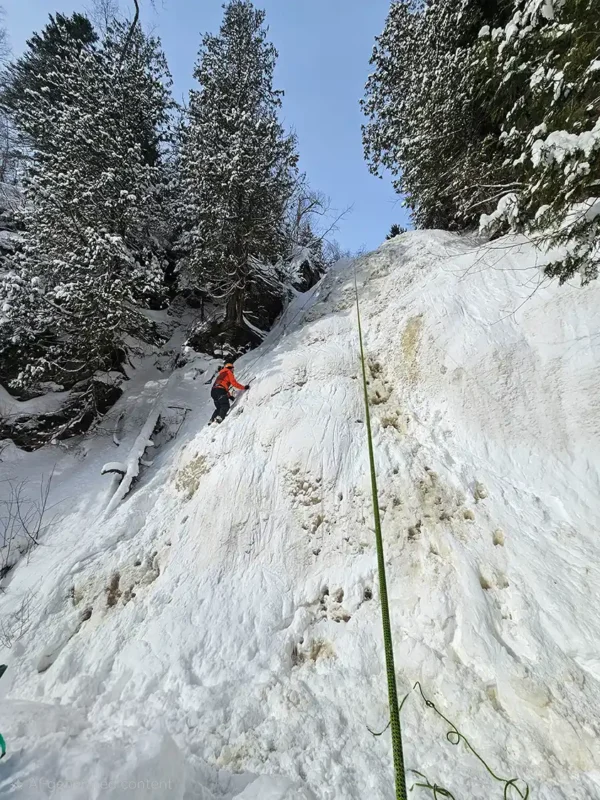
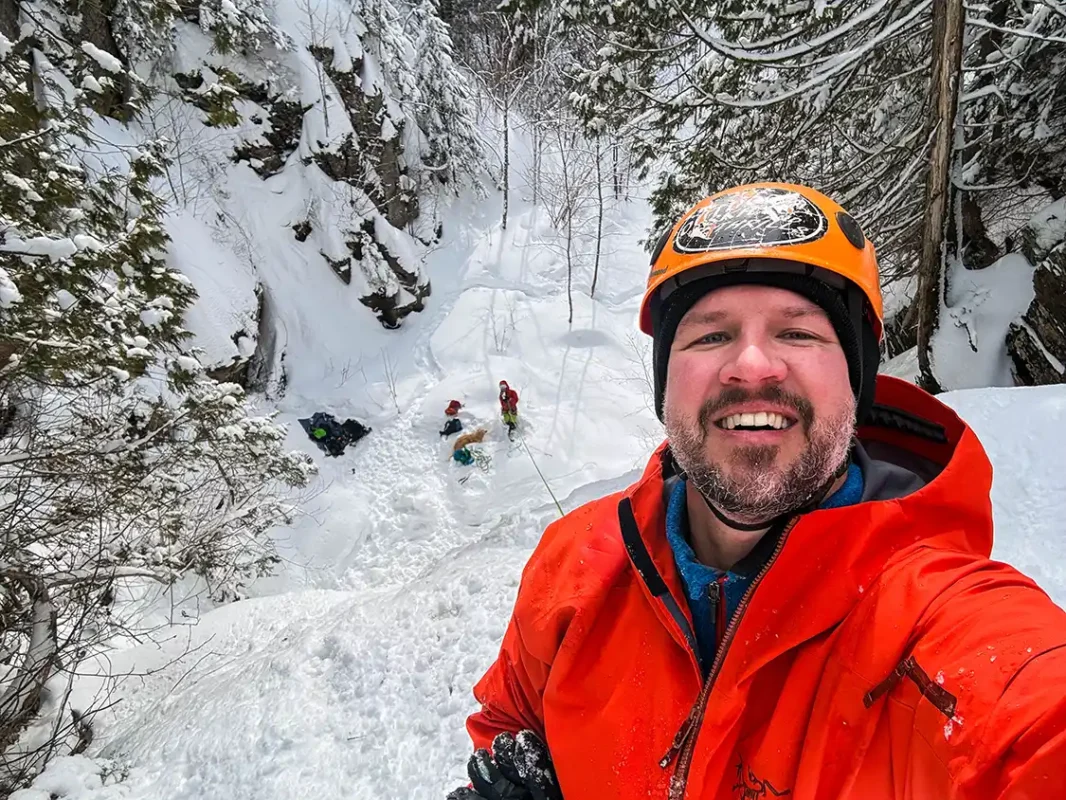
My first ascent was tentative. Crampon into the ice, step up, axe above the head, repeat. Not quite trusting the equipment or Aric’s expert hold on the rope. The moves are simple in theory and considerably more demanding in practice. Your calves burn faster than you expect. Your grip tightens instinctively even when it doesn’t need to.
But somewhere around the third climb, something shifted.
Axe, crampon, step. Axe, crampon, step. The rhythm of shifting my weight from foot to foot started to feel less like effort and more like a conversation with the ice. I found a route, committed to it, and moved with something approaching confidence. About two thirds of the way up I paused to breathe. My crampons were anchored firmly. My axes held confidently above me. I closed my eyes and exhaled slowly, the wintry mist gathering in front of my face.
That was when I heard it. The waterfall gurgled quietly beneath the frozen surface I was standing on. A sound so peaceful it seemed to come from somewhere inside me rather than underneath the ice. I felt completely present in a way that is genuinely difficult to convey.
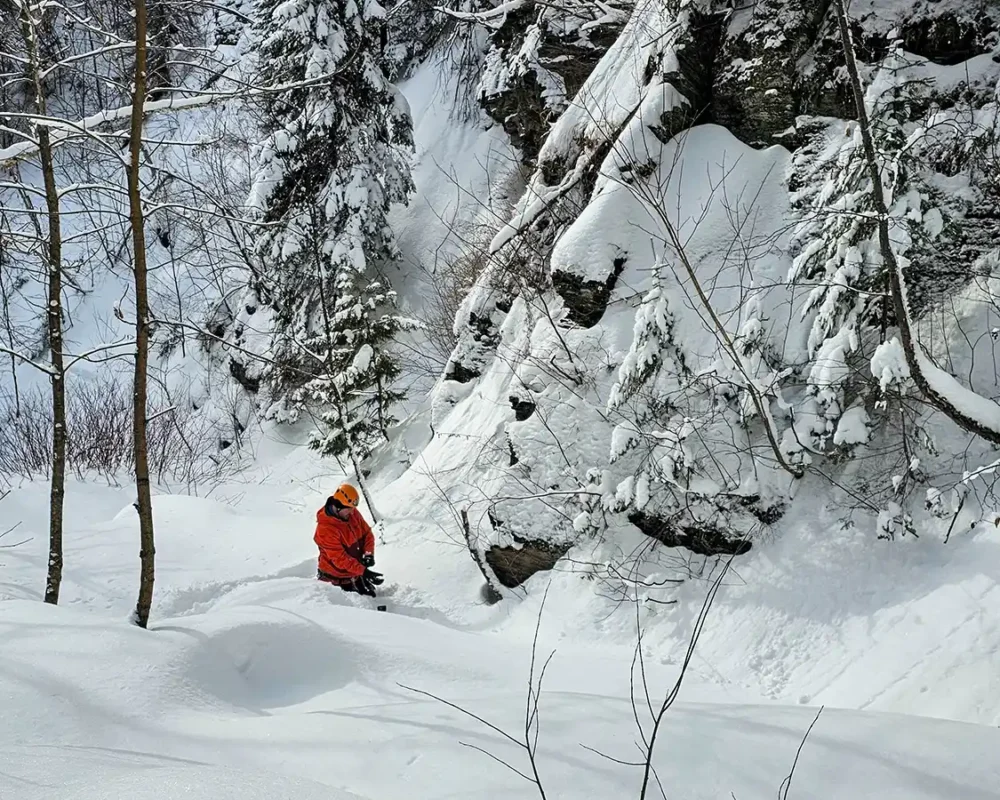
One moment of full disclosure: I did attempt to set up a GoPro to capture the action from a better angle. I wandered over to what I thought was solid ground without putting my snowshoes back on first. Within seconds, I was waist-deep in powder, tunnelling through the snow like a five-year-old building a fort. Aric watched with the patience of a man who has seen this before.
The GoPro footage was not worth it. The laugh was.
Why Ice Climbing Is More Accessible Than You Think
I’ve had the pleasure of experiencing rock climbing all over the world. I even spent a brilliant day climbing in Suesca, Colombia, where Erwin Kraus first dreamt up the idea as a training method for mountaineering back in 1938.
One thing that genuinely surprised me about ice climbing, however, was how accessible it proved to be compared to rock climbing. On rock, you are constantly searching for natural holds in a landscape that gives you exactly what it gives you and nothing more. On ice, if your axe bites and your crampon holds, you can create your own route. There is a problem-solving quality to it that rewards creativity as much as strength.
Getting to Thunder Bay From Toronto

The flight from Toronto to Thunder Bay is shorter than the drive from downtown Toronto to the other side of downtown Toronto on a Friday afternoon. Air Canada and Porter both service the route regularly, with flights from both Pearson International and Billy Bishop Toronto City Airport.
Once you land at Thunder Bay International Airport, a rental car is your best option for accessing climbing areas outside the city. Most ice climbing locations sit between 20 and 60 minutes from downtown Thunder Bay, making a car essential for getting the most out of your trip.
A long weekend is genuinely enough time to experience what Thunder Bay has to offer on the ice. Fly in Friday, climb Saturday and Sunday, fly home Monday. You will arrive back in Toronto with sore forearms, a head full of stories, and a completely recalibrated sense of what Thunder Bay winter adventures are capable of delivering.
Planning Your Ice Climbing Trip to Thunder Bay
Who to Book With
Outdoor Skills and Thrills is the go-to guiding operation for ice climbing in the Thunder Bay region, particularly for beginners and intermediate climbers. Aric has spent years developing deep knowledge of the region’s climbing locations and conditions, and his ability to read the ice, assess safety, and adapt plans on the fly is what separates a great day on the falls from a dangerous one.
Contact him directly through his website, and do it well in advance during the peak winter months.
Where to Go Ice Climbing Near Thunder Bay
The Thunder Bay region offers a remarkable range of climbing options across different skill levels. One of the things that makes Thunder Bay such a remarkable ice climbing destination is the sheer volume and variety of locations within striking distance of the city. Whether you have a full day or just a few hours, there is a route out there with your name on it.
Orient Bay is the undisputed ground zero of ice climbing in the region. Located roughly 90 minutes east of Thunder Bay and about 30 to 40 kilometres north of Nipigon, this glacially carved gorge holds over a hundred climbing routes ranging from beginner-friendly to genuinely demanding. If you are serious about ice climbing in Northern Ontario, Orient Bay is the destination.
Kama Bay, about 20 kilometres east of Nipigon, is considered one of the region’s best-kept secrets among climbers. A huge variety of routes at varying heights and difficulty levels makes it a strong choice for mixed groups or those looking to push into more technical terrain.
Closer to the city, Thunder Bay itself has multiple climbing locations as close as a 15-minute drive from downtown, with approaches that add a solid element of adventure to the day. South Gillies and Neebing, both recently developed by Aric, offer excellent half-day and full-day options across a wide range of difficulty levels, with shorter approaches that make them ideal for beginners or those working with limited time.
Ice Climbing Safety and What to Know Before You Go
Use a certified guide, particularly if you aren’t familiar with the conditions in the Thunder Bay region. Local guides know which formations are safe, which routes suit which skill levels, and how to read ice that looks solid but may not be.
Dress for the temperature, not the activity. You will generate significant body heat while climbing, but cool down quickly during breaks. Moisture-wicking base layers, an insulating mid-layer, and a windproof outer shell are the foundation. Bring an extra warm layer for rest periods and avoid cotton in any layer.
Ice climbing in the Thunder Bay region is suitable for ages six and up when conducted with a qualified guide using appropriate equipment. But always check with your guide first to see if they have equipment that will fit children.
Ice Climbing in Thunder Bay FAQ
Book directly through Outdoor Skills and Thrills at outdoorskillsandthrills.com. Availability during peak winter months fills quickly, so booking at least a few weeks in advance is recommended.
Late December through March offers the most reliable conditions. January and February are generally the strongest months for fully formed ice, though conditions vary annually. Your guide will have the most current read on what’s climbable.
No. Local adventure companies offer fully guided beginner experiences that include all equipment and instruction. A reasonable level of physical fitness helps, but no prior climbing background is required.
A full guided day typically runs five to seven hours, including travel to the climbing location, instruction, and multiple ascents.
Your guide provides all technical equipment, including crampons, ice axes, ropes, and helmets. You are responsible for appropriate winter clothing: waterproof boots with ankle support, insulating layers, warm gloves, and a hat.
Yes, with a qualified guide and appropriate equipment. The minimum age for guided ice climbing in the Thunder Bay region is generally six years old.
Yes. Beyond Thunder Bay, popular ice climbing areas in Ontario include the Niagara Escarpment near Collingwood and Owen Sound, the Bancroft and Haliburton regions, and areas around Wawa and the Algoma Highlands. Thunder Bay remains the standout destination for volume, variety, and accessibility to world-class frozen waterfall climbing.
Thunder Bay Ice Climbing Is Waiting For You
Thunder Bay is ninety minutes from Toronto. It has hundreds of frozen waterfalls, expert guides, exceptional food, and the kind of Northern Ontario landscape that resets your thoughts about what this province is capable of delivering.
Most people still aren’t talking about it. That is their loss and your opportunity.
Have you tried ice climbing in Thunder Bay or anywhere else in Ontario? Drop your experience in the comments below, and share this article with someone who needs a reason to get outside this winter.
Disclosure: This experience was done in partnership with Visit Thunder Bay. All opinions remain my own.
You May Also Like To Read:

Kevin Wagar is a founder and editor of Ultimate Ontario. He has been working in the travel media industry since 2015 when he founded his family travel website Wandering Wagars – Adventure Family Travel.
Over the years Kevin has developed a deep love for his home province of Ontario and aims to showcase the incredible experiences and amazing small businesses found within it.